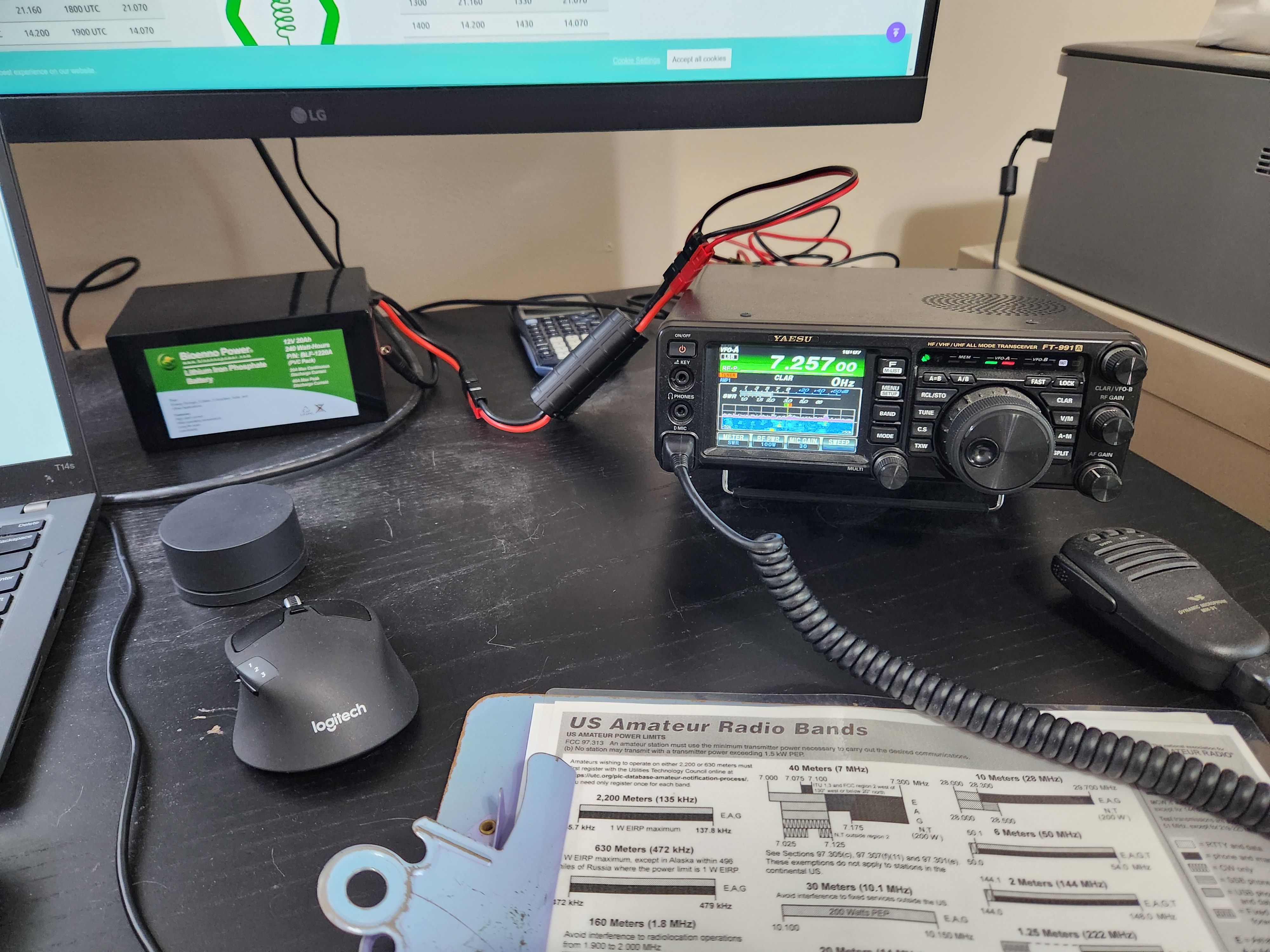
Winter Field Day 2026 -- Playing Radio During Winter Storm Fern!
Winter Field Day (WFD), occurring annually during the last full week in January, is an amateur radio event aimed at providing operators a chance to strengthen communications preparedness in the event of an emergency or disaster, especially during the winter season. My Field Day experiences are limited, as I’ve only previously participated in a couple of ARRL Field Days: once in my backyard and once with my local club (Amateur Radio Club of Columbia County K4KNS), and they were both short activities. I’ve never participated in WFD exercises, and I was looking forward to getting together with the club again for some weekend on the air activities. Unfortunately, with Winter Storm Fern threatening an ice storm in the Augusta area (and the state of Georgia under a declared state of emergency), the club decided to cancel the event to ensure the safety of our members.
A couple of weeks ago, we constructed a simple fan dipole (with 80, 40, 20m legs) and deployed it in our yard. Because I haven’t had much time to operate on it yet, I decided to spend the weekend participating in WFD from home while waiting to see what the weather had in store for us. I had plenty of options for multipliers, from copying the special bulletin to operating for six continuous hours, not to mention a few power and transceiver options, so why not? Where else was I going to go?
Before the event, I made sure I had everything I needed and batteries charged and ready to go. I also wanted to take advantage of having my computer nearby for logging: in the field, we log our QSOs on paper and later transfer them to HAMRS, so I wanted to see what I thought of logging my QSOs as I went.
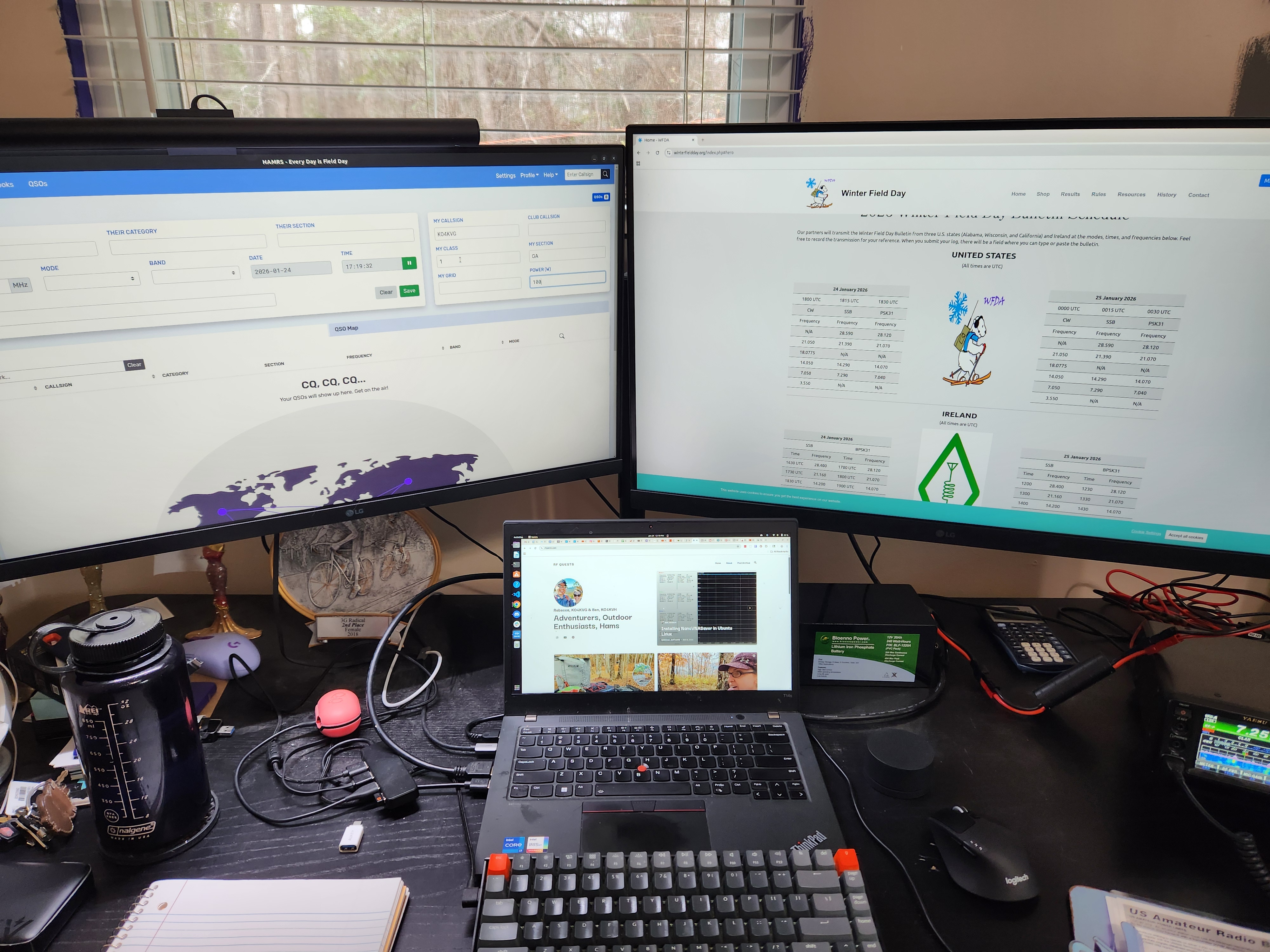 KO4KVGs WFD Ham Shack.
I started operations on the air at ~17:15 UTC on January 24. My initial approach to making QSOs was to just spin the dial on my Yaesu FT-991A and see what I could get. Since my transceiver was already set on 40m, I decided to start there. Within about 40 minutes, I made my first four QSOs. I then hopped over to 20m, and by that time, we were almost ready to hear the first bulletin, which I copied to the best of my ability. Thankfully, it was repeated so I could check my copy and update it where needed.
I stayed on 20m for a bit, and 11 QSOs later, including one where I hunted Del N2NWK for POTA, I decided to mix up my normal operating routine of going back and forth between 20 and 40m. It had been awhile since I’ve tried to make a QSO on 10m, and I wanted to see if the internal tuner on the FT-991A would allow me to operate on 10m with our new dipole. I was able to make one QSO in OR; however, the SWR was uncomfortably high, so operating on 10m is going to require some additional work. Unfortunately, I did not have an easy option available to operate on 10m during WFD, but I now know that if I want to operate on 10m at home, I need to invest some time into setting up an alternative.
Moving on from 10m, I decided to explore a band that I’ve never operated on: 15m. The internal tuner in the FT991A easily tuned on 15m, after which I started spinning the dial, and I was able to make several QSOs, including a few from out west (AZ) that I don’t regularly get on 20 and 40m. Challenging myself to see if I could work some new states on 15m, I decided to pick a frequency and start calling CQ. In less than 30 minutes, I made 11 QSOs, with two of them from states I’ve never worked before, this time in the northeast (ME and VT). Though not the busiest pileup I’ve ever worked, I enjoyed making QSOs with folks that I don’t normally reach during my usual POTA activations.
After going back to 40m for a little bit, and then back to 20m to catch the second bulletin, I decided to take a break for dinner. I also saw that my LiFePO4 battery was running low after 7h of mostly continuous operation at 100W and needed charging, so I figured this was as good of a time as any to take a break!
By the time I finished dinner, it was about 01:30 UTC (January 25), and as my battery wasn’t fully charged, I moved over to commercial power, thus losing the bonus for operating 100% on alternative power. As nighttime was approaching, I decided to spend the rest of Day 1 on 80m: seven QSOs later, I called it at 02:36 UTC. I walked away with 44 QSOs, which put me in a decent position to see if I could make at least 100 QSOs by the end of the event.
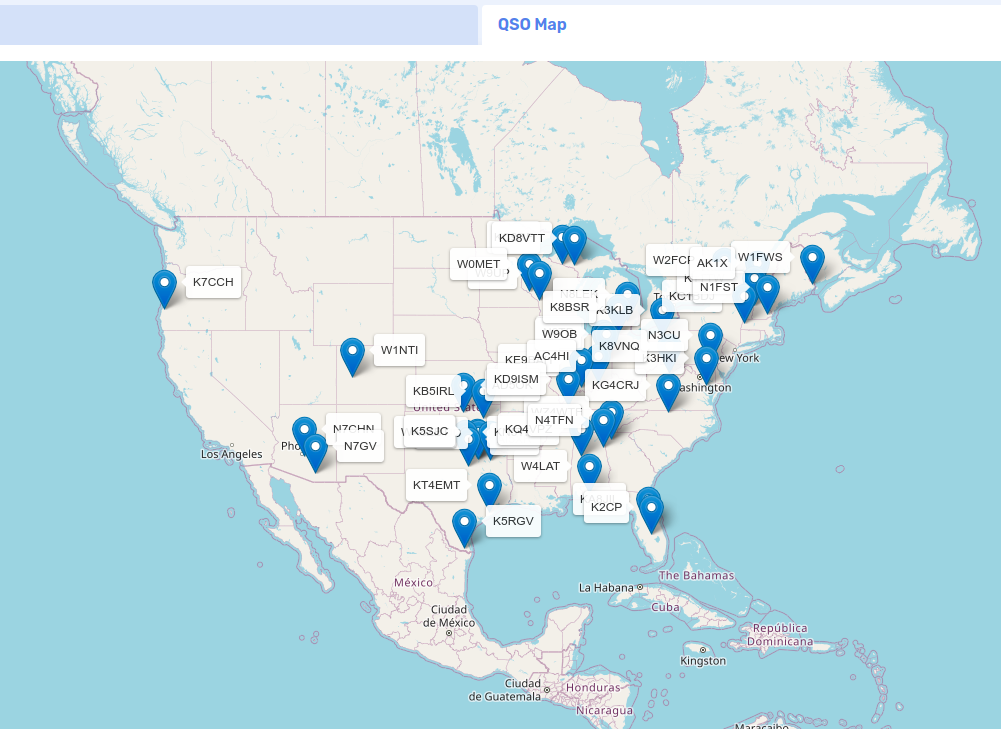 KO4KVGs QSOs at the end of Day 1.
With this goal in mind, I was ready to approach Day 2. Fortunately, I woke up to having power in the house, as the rain and ice didn’t make it our way. I got on the air at about 13:15 UTC on January 25 and made a few QSOs on 20m while having coffee. After a brief break, I returned to the air and picked a frequency on 20m to call CQ. I worked a pileup for about 30 minutes, making 26 QSOs.
As I enjoyed making contacts on 15m the day before, I wanted to get back on the band and see if I could possibly get a DX contact. I spun the dial, and sure enough, my next QSO was EI0WFD in Ireland! They’re the folks from Online Amateur Radio Community Ireland EI2OARC that transmitted the WFD bulletin in Europe. I was glad to see they stuck around for QSOs and glad I was able to successfully break through the pileup and make contact. I spent about 2h on 15m (with a lunch break in between), making 27 QSOs; in addition to my DX contact from Ireland, I worked some new provinces in Canada (Quebec, Prince Edward Island), as well as another new state (MN). I also made a contact with YouTuber Ham Radio with K0BF in CO, where I ended up on his WFD livestream (~3:42h - 3:44h mark, ~20:04 UTC). It was pretty neat to hear myself on the playback trying to break through the pileup and successfully making the QSO, as of course, we don’t get that perspective when we’re at our radio.
As the end of WFD was approaching, I concluded the event on 40m. When 21:59 UTC hit, I had made 108 QSOs over 5 different bands (10, 15, 20, 40, and 80m), and I had made contacts with one new country (Ireland), two new Canadian provinces (Quebec and Prince Edward Island), and seven new US states (AR, ME, MN, MS, NV, NH, VT). This is easily the most QSOs I’ve made in a single weekend. Although I still had my voice at the end of the event, it’s definitely a different type of stamina when you’re operating on and off over the course of a couple of days vs. when I’m doing a POTA activation in a park or going on a 20 mile “day hike” for a SOTA activation. I think I’ll take WFD indoors over another one of KO4KVH’s day hikes…
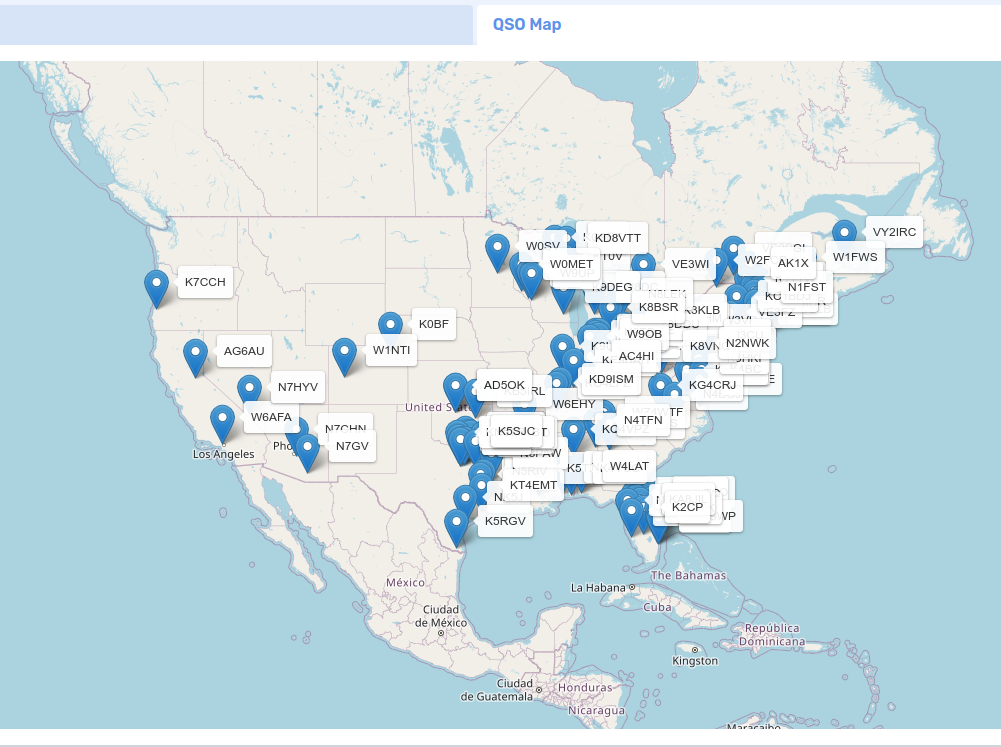 KO4KVGs QSOs at the end of Day 2 (QSO with EI0WFD not shown).
Though I kept my pen and paper close to write my QSOs down and take notes, it was really nice being able to log them into HAMRS on my computer as I went. Not only did it eliminate the need to log all 108 QSOs after the event, it also prevented me from having to rely too much on reading what I scribbled down several days later, as the exchanges were fresh in my mind. I’ll certainly have to consider bringing an electronic device out in the field to log as I go, especially if I plan to be on the air for extended periods.
Where our fan dipole is not resonant on 10m, I had a lot of fun on 15m, working stations in the western US, as well as some DX contacts, including EI0WFD. An alternative setup to operate on 10m is now on my (long) to-do list.
I also learned that my LiFePO4 battery (Bioenno 12V 20Ah) will last ~7h while operating pretty continuously on 100W. This is a valuable metric for future operations, emergency or otherwise.
Although I missed the camaraderie of enjoying the WFD with my local club, there will be other operating opportunities where we can enjoy the time together without stressing over how we’re all going to get home with ice on the GA/SC roads. Springtime can’t get here soon enough!
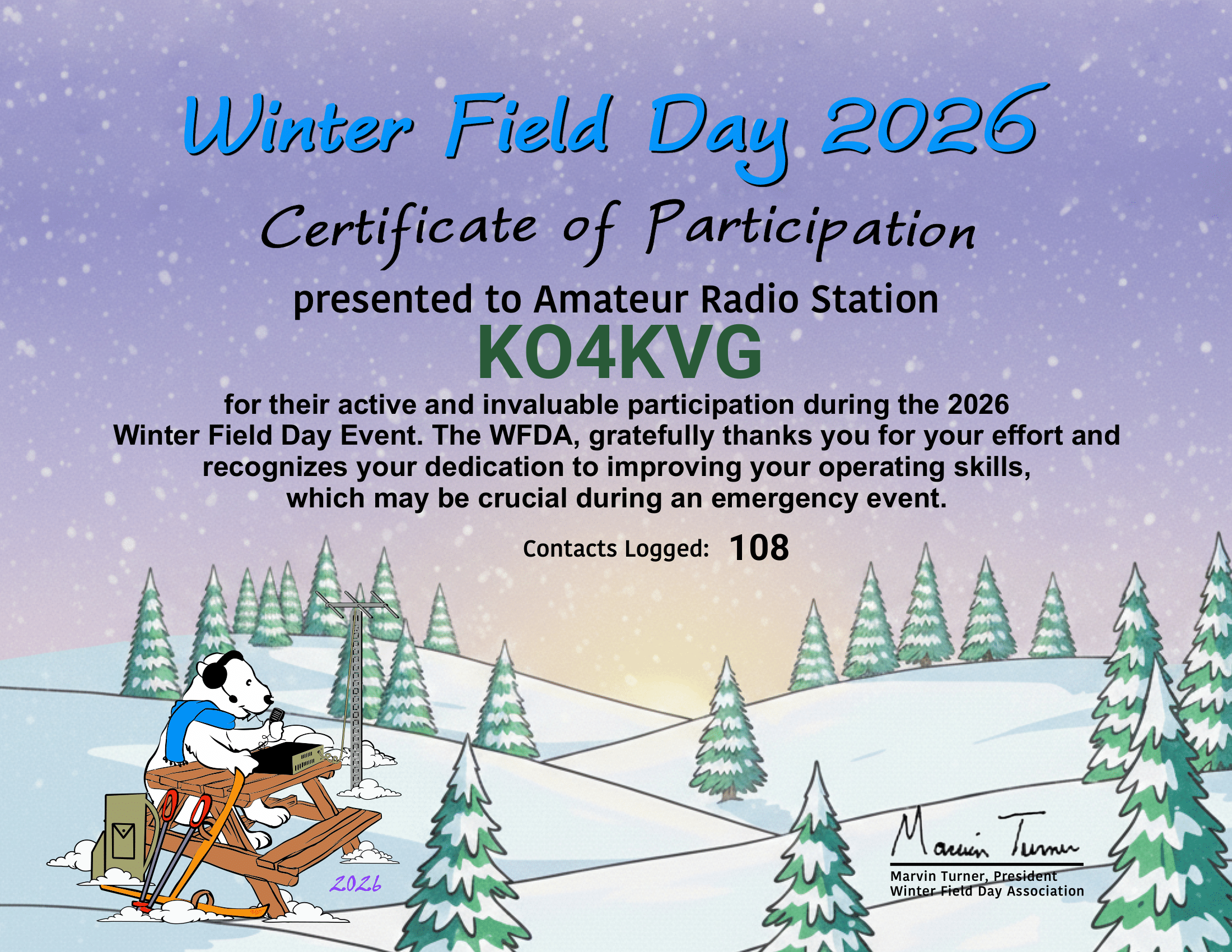 WFD Certificate.
Until then,73! KO4KVG
